Total Pageviews

Friday, 7 July 2017

HAPPY BIRTHDAY BRIAN DENNEHY

Like many film and TV fans, I bang on about the stars we label as 'greats' because they are great. But I also love the magnificent supporting actors who don't always get the recognition they deserve. And then there is another category, the actors who just get on with the job and who don't seem bothered about status. I might be wrong but I'm thinking here of Brian Dennehy. I happened to see him last night in an episode of The Blacklist, the James Spader crime show, and I thought I'd write a bit about him, undoubtedly a terrific actor, one of my favourites, someone who warms the credits of any production and someone who was kind enough a few years ago to send me a signed photograph.

As it happens, 9 July will be Brian Dennehy's 79th birthday, so the timing is good. He was born in Connecticut in 1938 and raised in New York. He was a history major, then a US Marine and later a stockbroker, as well as a sporty type and a dramatic arts student. He came to screen prominence as the antagonistic Sheriff Will Teasle in First Blood (1982) tussling with Sylvester Stallone's John Rambo.

His early TV roles included Kojak, M*A*S*H, Lou Grant, Dynasty and Knots Landing. Early film parts included Semi-Tough, Foul Play and Butch and Sundance: The Early Days. But First Blood was the one that made the difference to his career. He continued to work on the big and small screens, as well as in theatres.

He has chalked up a considerable list of movie credits: Silverado, F/X, Legal Eagles, Best Seller to name a few but didn't neglect TV where he scored with the Jack Reed series of cop films. He gained wide acclaim for his role as Stourley Kracklite in The Belly of the Architect and for Death of a Salesman, playing Willy Loman both on stage and in a television film.

He has been nominated for and won many awards including Tonys for Death of a Salesman and Long Day's Journey Into Night. He also won a Laurence Olivier award for Salesman, as well as a Golden Globe.

He has appeared in stage productions across America, as well as in Canada, Dublin and London.

Brian Dennehy is a brilliant screen and stage actor, to a lot of people a man with a very recognisable face and huge presence (he's a big guy!), although they might not always remember his name.

In August 2005, he was appearing in Death of a Salesman in London. I wrote to him asking for an autograph. He sent back this signed photo.


I rate him highly. Happy birthday for the 9 July, sir and thank you for all the great work over the years.

Wednesday, 5 July 2017

YUM, YUM - SPAM AT 80


When I was growing up as one of seven children in the late 1950s and through the 1960s, meals seem to fall into a loose pattern. On Sundays we had roast chicken or roast beef or pork fillet. On Mondays we had something called vegetable roll which was actually round slices of meat like beef burgers. Tuesday’s were stew days, Fridays were fish and Saturdays were fry days. My mother was a great magician in the kitchen, almost always cooking from scratch. She was a great baker too. Even when money was tight, as it often was, we always seemed to enjoy great food. And I don’t remember eating much processed food until I became a little more adventurous and started to experiment with exotic concoctions like Vesta beef curry which was basically rice and dust boiled into something that might have been better suited to the bottom of a budgie cage. There was spaghetti and macaroni cheese in tins, and Fray Bentos steak and kidney pies too. In a stroll down memory lane, I tried macaroni cheese not so long ago and, perhaps because of my more mature and discerning palate, it was ghastly with a claggy aftertaste. Over 50 years ago, I thought is was superb!

Aunt Sheila was the start of my quest for ‘foreign’ food. She had the amazing idea to sprinkle curry powder onto stew and, wow, what a revelation that was. Extraordinary and delicious. From the first spoonful in my pre-teens, my taste buds were transported from local Belfast grub to a hankering for international dishes.

Occasionally, in the summer, our salads would invariably include ham, sometimes in slices from the grocer and from time to time from a tin. Ye Olde Oak was a brand. It was a near-oval-shaped tin and, like some canned food, you took your life in your hands to open it without incurring an injury. As I recall it, the ham was perfectly good and tasty, coupled with slices of hard-boiled egg and smothered in Heinz Salad Cream. We had luncheon meat too, cheap and cheerful pink meat to keep all those kids happy.

Spam, which was launched 80 years ago, must have featured at some point in our cuisine. On days when my mother was probably wracking her brain to think of what to cook for her magnificent seven, the odd tin of prepared food must have played a part. I don’t remember ever eating Spam but I suspect I did sometimes. So, on this keynote anniversary, I decided to take another stroll down memory lane. I bought a tin and looked up the history of this famous product. In these days of evangelical chefs, self-appointed nutrition experts and celebrity faddy diets, when we seem to be bombarded with lists of things that are good and bad to eat and drink, Spam and other convenience foods are frowned upon. But it shouldn’t be forgotten that sometimes on restricted budgets families may have little choice but to opt for inexpensive food. Pious, snobbish and puffed-up TV cooks should stop waving their ladles at us from their pulpits.

Spam emerged in 1937 as a simple convenience food brand made by the Hormel Corporation, based in Austin, Minnesota, and it coasted along in its early years. But sales skyrocketed during the Second World War when it was next to impossible to supply troops overseas with fresh food. Tinned supplies proved to be a convenient and efficient way to feed U.S. military units in Europe and elsewhere and Spam became part of a loved and loathed foodstuff on a soldier’s daily menu. Apparently, Hormel kept a file for hate-mail from disgruntled soldiers who had endured the product often for breakfast, lunch and dinner on the same day. 

In its 80 years, it is estimated that nearly 10 billion tins of the product have been sold worldwide and there are dozens and dozens of recipe ideas to jazz it up and to keep it relevant and popular today. There’s Spam in its traditional tin and Spam in easy-to-open plastic tubs. There’s Spam with bacon and even Spam Lite. I opted for the 200g tin of the original at £1.75.


The blurb on the tin tells me its “the unique blend of prime pork & ham, minimum 90% meat”. The ingredients: pork (89%), starch, water, salt, ham (2%), sugar, stabiliser (trisodium diphosphate), flavourings, antioxidant (sodium ascorbate) and preservative (sodium nitrate), and its gluten free but may contain traces of milk. The nutritional information scores fat at 24.3g per 100g. There is a recipe idea on the back for Spam, egg and chips and guidance that I can eat this grilled, baked, microwaved or even cold. This tin, bought in July 2017, has a “best before” date of May 2020. So, if I had a nuclear bunker, I could stock up for the long haul. There is a handy illustration on the top on how to open the tin with a ring pull and a clear big red X warning not to use a tin opener. Although there are a few instructions on how to get the meat out of the tin, I had to resort to a knife for assistance. After a few manoeuvres, out popped a moist pink small brick, referred to in some quarters as “mystery meat”.


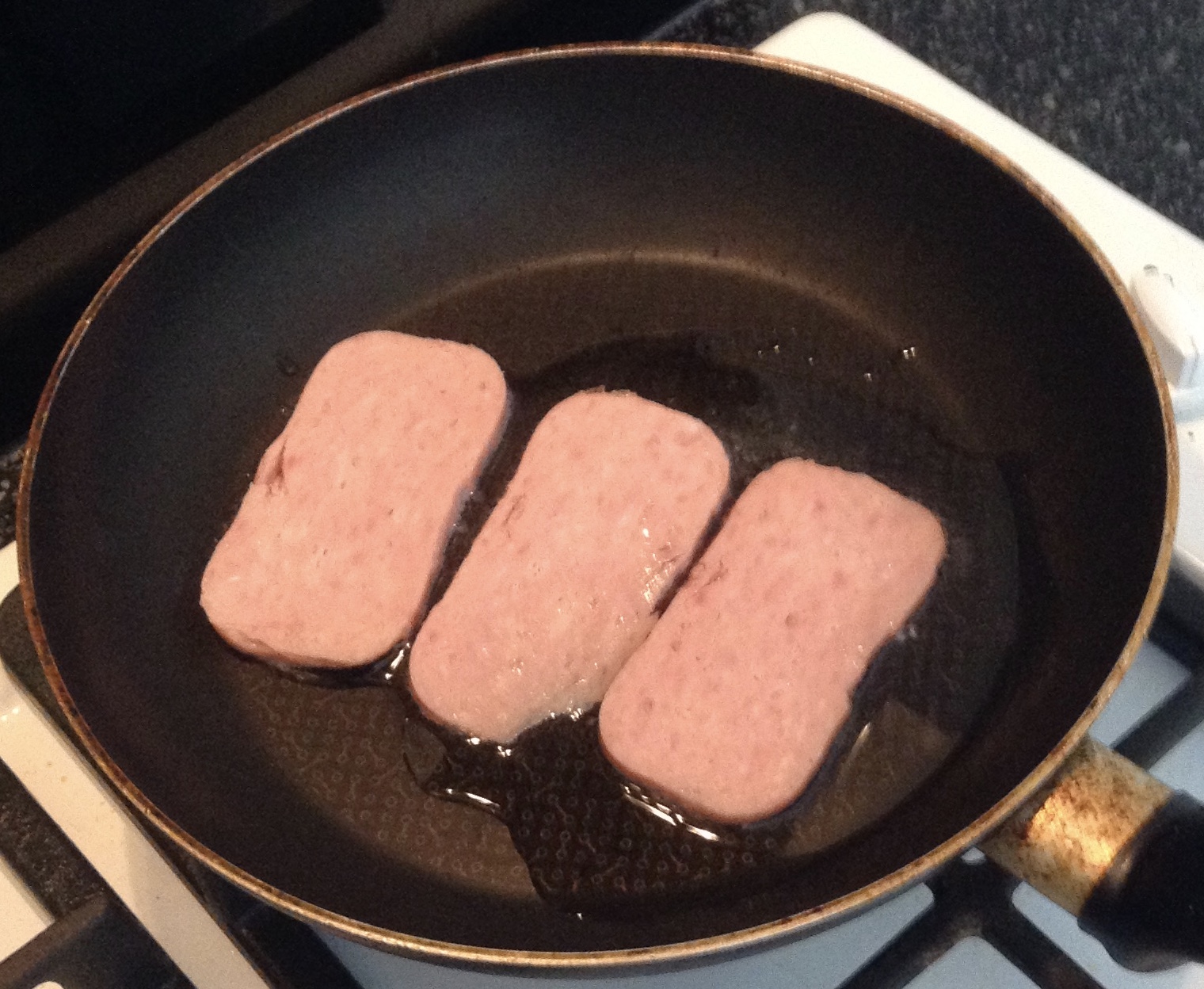
By the by, the origins of the word Spam are wrapped in mystery with some suggestion that it is a condensed version of spice and ham. We can knock that one on the head, I think, as pork is the dominant ingredient, it indicates that a more correct name would have been Spork. I decided on two ways to eat it. First, I sliced off a couple of pieces and got stuck in eating it cold. I don’t know what I was expecting but it is mild, a bit boring and quite salty but not unpleasant. It would probably work better in a sandwich with tomato and pickle or some other creations. Next, I fried three slices until they were just on the cusp of crisp. I noticed quite a bit of fat in the frying pan that I had only lightly oiled. The fried version is definitely better with a flavour not dissimilar to bacon, unsurprisingly. But it was saltier and the taste lingered for a while, annoyingly. On the whole, cold okay, hot better. (Two hours after eating the Spam, I know I’ve eaten Spam. It lingers!)


Will I buy it again? The straight answer is no. I can understand its popularity as a convenience food but it’s not my thing. Like my mother, I cook mostly from scratch and steer clear of ready meals in tins or packets. I don’t condemn anyone for their preferences and there are clearly many people who like their tinned meats. There is a fair amount of supermarket shelf space given over to it and that only happens if there is customer demand.

Spam has attracted both praise from its fans and ridicule, the latter exemplified in the classic Monty Python Spam sketch and song, which in turn begat the global hit musical Spamalot. The musical, the brainchild of Eric Idle, is not about Spam at all. It is a bawdy and irreverent spoof on King Arthur and the Spam pun was used simply to highlight its Pythonesque connections. (From the Python cafĂ© sketch: “Lobster thermidor aux crevettes with a mornay sauce, served in a Provencale manner with shallots and aubergines, garnished with truffle pate, brandy, a fried egg on top and Spam …….spam, spam, spam, spam ……). Weird Al Jankovic’s comedy Spam song suggested that any Spam left over could be used for bathroom grout.

There’s even a Spam Museum (“Please don’t eat the exhibits”) in Austin, Minnesota and an annual Spam Jam festival in the city. Hawaii hosts a Spam festival too every year. Chefs in fine restaurants conjure up all kinds of classy and fancy recipes and fans wander about Waikiki in their I Love Spam tee-shirts and baseball hats enjoying the splendour of their beloved Spam. Some excited attendees even dress up as tins of Spam. As I say, praise and ridicule. As Spam repeats on me, I repeat it is not unpleasant and has a place on my menu of last resorts.

Of course, for this generation, the word has been hijacked to describe unsolicited, unwanted and sometimes illegal email, tons of cyber rubbish that clogs up the internet and frustrates people on a daily basis. Now that really is unpleasant!


Tuesday, 4 July 2017

MEMORIES FROM N IRELAND AMATEUR DRAMATICS 1940s/50s

Today in 1931, the Northern Irish film star Stephen Boyd was born at Doagh Road Corner, Whitehouse. He grew up in Glengormley and is always associated with Belfast’s theatre groups and some further afield across the six counties. Some time ago, when I was researching his life, I received a fascinating letter from a Carrickfergus man called Thomas Kemp who knew Stephen Boyd in his William or Billy Millar days. This was pre-Hollywood, The Man Who Never Was, Ben-Hur and The Fall of the Roman Empire. These were the days, late 1940s and early 1950s, of travelling repertory companies, jobbing actors and playwrights, amateurs out to earn a few extra shillings on top of their day jobs while doing entertaining work that they clearly enjoyed.

As with any enterprise, money was at the heart of things with rep companies having to beg and scrimp for finances to buy scenery or cover petrol costs. Thomas Kemp said that some authors would accept a modest fee for their scripts while others, cannier, would seek out a percentage of ticket sales. If they were lucky, the actors would earn a few quid but how much depended on the size of audiences at village and town halls. The prices of admission in those days generally ranged between 2/= and 2/6d with flimsy programmes between 2d and 3d. 

Mr. Kemp recalled that his company was fortunate to have one local supporter in the building trade who conveyed stage scenery to and from various locations in a lorry. Not all companies were that lucky and it was not out of the question for sheets of plywood and other materials to be strapped to the tops of vehicles and driven up and down the country with drivers praying for no sudden gusts of wind. The members of the cast were taken by people affluent enough to own cars. Cadging lifts and relying on the goodwill of others were vital parts of this wayward life. The question of staying overnight did not arise as players and stage hands always performed in towns that were accessible to travel to nightly and return home. To do otherwise would have required considerable financial backing, which would have been next to impossible to obtain in those years.

In many of the country halls facilities were not always of a very high standard and improvisations were always necessary. Dressing rooms were very often one room, which had to be divided by creating curtained divisions to separate male and female cast members.  Such accommodation would invariably only include one toilet to cover all, so it was inevitable that situations arose when males and females would enter a toilet that had no lighting only to find it occupied by a member of the opposite sex.  Shouts of ‘hey’ and ‘occupied’ and, perhaps the odd scream were not unusual backstage.

Each production had a prompter in the background should cues or lines be forgotten and also to provide sound effects which might be required in the play.  Mr. Kemp remembered one occasion a prompter suddenly realised during the performance that he had to give the effect of thunder in the distance but he had nothing in his possession to create this effect.  He was
engrossed in the play, holding the script in his right hand, with the left arm extended.  The prompter beckoned to one member of the cast who was not on stage at this precise moment to find him a piece of wood.  The member concerned was a bit of a wit and immediately rushed away and returned with a lavatory seat that he draped round the prompter’s extended arm.  Of course this went down like a lead balloon. There was no thunder sound effect on that occasion but the noise of a disgruntled prompter made up for it once the play was over. Pranks, frustrations and unexpected incidents went with the territory. The spirit of comradeship was very strong and the odd, silly joke was almost always accepted in the best possible manner. 

On another occasion, Mr. Kemp and friends travelled to Dublin by rail to take part in an annual dramatic festival.  When making the return journey, the train pulled to a standstill at the last stopping point before crossing the border into Northern Ireland.  As a general rule, the train remained stationary for a fairly lengthy period of time to enable the customs men to interrogate passengers about prohibited purchases.  One of the cast decided he would leave the train and buy a drink and still have time to rejoin the train before it left.  However, on this occasion the train did not wait as long as usual. The last the company saw of their friend was him standing on the platform waving frantically and shouting furiously as the train steamed out of the station. The next day, having thumbed lifts to get home, the hapless colleague never tired of telling the story as only an actor can with all the necessary pathos, humour and, of course, exaggeration.

During this period Billy Millar was dabbling in amateur and, occasionally, professionally paid theatrical jobs doing all sorts of small parts, shifting scenery or whatever was required. He was aged around twenty. Thomas Kemp was hired to play Archer Boyd in Boyd’s Shop at a hall in Ballymena in February 1951 but he was struck down by a severe bout of the flu. At short notice, Billy Millar deputised and was paid the handsome sum of £3.3.0 for his services. (Thomas Kemp sent me a photocopy of the cheque, issued by Northern Bank Limited, Carrickfergus branch, on 13 February 1951.) 


Billy Millar, as we know, went on to become Stephen Boyd and enjoyed a few bigger cheques in his time as one of cinema’s most popular actors. But his beginnings were humble and there is little doubt that ramshackle and seat-of-the-pants repertory work across Northern Ireland acted as a sort of apprenticeship in his career. From rep work, he progressed to various roles in Group Theatre productions before travelling to England and more stage roles in the Midlands, Windsor and London. He evolved from bit-part player to leading actor in acclaimed productions of A Streetcar Named Desire and The Deep Blue Sea. It is sad that when his cinema career waned in the late 1960s that he didn’t have any appetite to return to the theatre but who knows, had he not died in 1977 at a shockingly young 45, what he would have done with his considerable skills, skills embedded and nurtured all those years ago in Northern Ireland’s breeze-block town and village halls.