Total Pageviews

Saturday, 7 May 2022

BOOK REVIEW: REPORTING THE TROUBLES 2 - COMPILED BY DERIC HENDERSON & IVAN LITTLE


Blackstaff Press 2022

https://blackstaffpress.com/reporting-the-troubles-2-9781780733258

Reporting the Troubles 2

More journalists tell their stories of the Northern Ireland conflict

Compiled by Deric Henderson and Ivan Little

Foreword by Bertie Ahern and Sir Tony Blair


This book (and its predecessor, Reporting the Troubles, published in 2018) is, on a deceptively simple level, a book by journalists about journalism. But it is so much more than that. Book 1 and Book 2 are recollections of some of the most harrowing and deplorable events that happened in Northern Ireland in relatively recent times.

"Reporting on the tragedy of what happened here in the last five decades was never easy. It took a certain kind of journalist to head off into the night to report from the scene of the latest murder, to listen to heartbreaking stories of the lives destroyed by the conflict, and to try to make sense of it all." (Mark Carruthers).

The memories of death, injury, destruction and brutality are told vividly and also with humanity for the victims and their families. These are people stories that I read with stirred emotions, often with a tear in my eye or with raging anger.  I was struck by many things but when reading about babies, young children and others who were killed by "mistake", followed by a blasé "oops, sorry, but our campaign continues" from paramilitary outfits, I could feel the intensity of my blood boiling.

On one side of these narratives, there is despair and everlasting grief. On the other, there is a clinging to a sincere desire that the current fragile peace in Northern Ireland will one day become something more solid cemented by hope.

Another running thought as I read these brilliant pieces of journalism was the attempts by some individuals and organisations to wipe the slate clean, to erase the past as if it never really happened or mattered. How wrong would that be? What an insult to those who died, those who can never forget and those whose pain and torment never fade!

"In Northern Ireland there is a word for dealing with the past. It is a word for the killings during the Troubles, the murders, assassinations, the abductions, the bombings, the dreadful mistakes, the people who were simply in the wrong place at the wrong time. We call it legacy. But legacy is difficult, because legacy lasts a lifetime. (Will Leitch)

This is not always an easy read but it is an essential book that (along with its previous companion) should be read widely for years to come. There is truth here, truth told by great journalists via exceptional journalism. Without these extraordinary people, quite a few dealing still with their own recurring nightmares, the past really would be forgotten. Journalism at this high level really does make a difference. 

"We dedicated the first volume of the book to the victims of the Troubles and they and their families are still at the heart of this second book. We hope that both volumes stand as an enduring act of remembrance." (Deric Henderson and Ivan Little).

An enduring act of remembrance, it certainly is. Highly recommended.

Wednesday, 4 May 2022

BOOK PROMOTION - THE STRANGER IN THE MIRROR BY RAKEYSH OMPRA MEHRA & REETA OMPRAKASH GUPTA

{Blogger's note. I have not read this book (no time, sadly) but I am happy to offer it and its authors some publicity}


The Stranger in the Mirror

by

Rakeysh Omprakash Mehra

with

Reeta Ramamurthy Gupta

Amazon Link: https://www.amazon.co.uk/Stranger-Mirror-RAKESH-OMPRAKASH-MEHRA/dp/9390547997/ref=sr_1_8?keywords=The+Stranger+in+the+Mirror&qid=1651674856&s=books&sr=1-8


ABOUT THE BOOK

The Stranger in the Mirror is the memoir of the legendary producer-director, Rakeysh Omprakash Mehra. Co-written by noted marketer-author, Reeta Ramamurthy Gupta, this book chronicles the richly experiential, multi-faceted life of one of India’s most celebrated and feted directors who has made critically acclaimed films like Rang De BasantiDelhi-6 and Bhaag Milkha Bhaag.

Though it may seem natural for an autobiography to have a primary narrator, what makes this book truly unique is its many narrators. It is this multi-dimensional, multi-character narration that will enable readers to delve deep and truly understand what it means to be as unselfish as Mehra, a man who gleefully steps back and lets the experts do their job.

Peppered with anecdotes from Mehra’s life—from the chai-biscuit college days to the popping of the proverbial champagne—it implores readers to pay attention to understand who is narrating, because the plot may have just shifted a little bit, just like his movies. At the end, what really stands out is how effortless the journey has actually been. And herein lies the greatest paradox because there is no lack of perseverance in this journey. The miraculous manner in which things fall into place naturally, like pieces of a pre-ordained puzzle with the universe acting as the ‘sutradhar’, is the fulcrum around which the joy of this remarkable journey is built. 

ABOUT THE STRANGER IN THE MIRROR

The Stranger in the Mirror, the memoir of BAFTA nominated ace director Rakeysh Omprakash Mehra, is penned by noted author Reeta Ramamurthy Gupta. This marks her foray into biographies- two more of which are in the pipeline. 

The book offers a multi-dimensional, multi-character narration of an unselfish protagonist, Rakeysh Omprakash Mehra, (lovingly called ROM by his cast & crew) a man who gleefully steps back and lets the experts do their job. The author projects Mehra as a passionate architect who endeavours to build a bridge between Indian & world cinema.                                    

There are several anecdotes spread liberally all over the book; and you have to pay attention to understand who is narrating - because the plot may have just shifted a little bit- just like his movies. Structured as a non-linear narrative, there are several paths the reader can take within the book. Each movie has its own trajectory, along with first person narrations by almost everyone he has worked with.  

Despite the obvious struggles, the miraculous manner in which things fall in place, like pieces of a pre-ordained puzzle, is the fulcrum around which the joy of this journey is built. The carefree days of penniless youth are every bit as exciting as the popping of the proverbial champagne. Here’s a roller-coaster ride hailed by Indian media as one of the best Hindi film biographies ever written.

The book is available on Amazon UK.


ABOUT THE AUTHORS

RAKEYSH OMPRAKASH MEHRA

Rakeysh Omprakash Mehra occupies a reverent mihrab of his own in the annals of Indian filmmaking. After working on almost 200 advertising films and a documentary, he found his calling on the big screen. His cinema is honest, powerful and holds a mirror to society. His unsentimentally crafted portraits of conflicts inside our own culture, the demonic behaviour of humans possessed by communal hatred, the inherent imperfections that humanize super-achievers, have always been ahead of their time. His brand of socially conscious, progressive filmmaking has its own signature. His work is archetypal, socio-political and philosophical spawning genres such as sports biopics and youth-oriented cinema. As a director, writer and producer, with a yen for timeless music, he established Flicks: The Motion Picture Company in 1987, which grew into Rakeysh Omprakash Mehra Pictures in the year 2004. He is married to P.S. Bharathi. They have a daughter, Bhairavi, and a son, Vedant.

REETA RAMAMURTHY GUPTA

Reeta Ramamurthy Gupta hails from the marketing world and applies her vast knowledge of connecting with audiences to her writing. Her ability to bring pages alive with a lexical diversity that assimilates cultures and timelines and gripping parenthetical narratives has created a unique imprint in Indian writing in English. She is credited with the internationally acclaimed Red Dot Experiment, a decadal six-nation study on how ‘culture impacts communication.’ Her previous book, Rescript Your Life, was published by Rupa Publications. She is married and has two children.


EXTRACTS FROM THE BOOK

Rakeysh’s RDB was a blockbuster at another level: one of the top five hits of all time. To celebrate, we released quarter-page ads on the front pages of all the national dailies. I got a call from Aditya Chopra and Karan Johar asking for a meeting at the former’s office. I was half expecting a reprimand for bringing out competitiveness by comparing RDB’s success and trying to put it on some rank. However, both of them were convinced that my intentions were pure and they spoke of the film with admiration. The non-formula movie had arrived and I realized that this kind of movie was what I actually meant when we set out to push the envelope.

The music was a cult hit with AR doing what only he can do. Rang De Basanti became India’s official entry for the Oscars and further won a BAFTA nomination.

Rang De Basanti was chosen as India’s entry in the best foreign film category at the 79th Academy Awards in 2007. We missed an Oscar nomination, but joined Pan’s Labyrinth, Apocalypto and Black Book among other nominees in the category of best non-English film at BAFTA. The film travelled to festivals across the globe and broke box office records at the same time.

It won the golden lotus at the National Film Awards for best popular film providing wholesome entertainment. It also won three silver lotus awards: the first for best audiography (Nakul Kamte), the second for best editing (Bharathi) and the third for best playback singing (Naresh Iyer for the song ‘Rubaru’). But the irony remains. As Kamlesh Pandey beautifully puts it, ‘As long as the State remains the enemy of the nation and politics keep killing its young, RDB will remain relevant.’

COMMENTS

‘He was the one that designed my french beard for his film Aks; I have not removed it since!’.

—Amitabh Bachchan

Tune to college ke bahar bhi life ko nacha diya, kaakkey. Tim-luck-luck-tim... Love you, Mehra.

—Aamir Khan

“I resonate strongly with the fearlessness in Rakeysh Omprakash Mehra’s films and his approach. He goes boldly into subjects that others would think twice about. He bats from the front foot!”

—Virender Sehwag, Cricketer

“It’s tough to constantly infuse your films with your own belief systems. Success or failure, Rakeysh has constantly done that. And that makes him a passionate and a true artist.”

—Shekhar Kapur, Filmmaker

“A master of the storytelling oeuvre, he has brought to life alternate narratives, whose success lies in their being relevant irrespective of the continuum of time.”

—Sanjoy Roy, Producer, Jaipur Literature Festival

“Read this book to understand the making of a genius.”

—Amish Tripathi, Bestselling Author

Rakeysh’s success is important because it is based on his integrity. Other than his obvious achievements, he is an icon because he has inspired millions of Indians to believe that cinema has integrity and soul.”

—N.R. Narayana Murthy, Founder, Infosys


Tuesday, 5 April 2022

SEARCHER (AFTER SPENDING TIME IN BELFAST CENTRAL LIBRARY'S NEWSPAPER ARCHIVE)

Sign in, fill in the request slip

And soon a man appears with a bound book

Of newspapers from the 1960s,

A time, as you browse the pages,

When housewives dreamed of washing machines

And vacuum cleaners as their Christmas presents

From lovingly generous, pipe smoking husbands,

When cigarettes were cool, chic and romantic

And milk was a lifestyle drink.

A time, in the petty sessions columns,

When fines were issued for playing cards

In the street, for losing control of pigs

On a public highway, for brawling,

For swearing at a clergyman,

And for shooting a duck on a Sunday.


Sunday, 27 March 2022

MOTHER MEMORY - BOBBLE HAT

  In the mid-60s, my mother knitted me an almost exact replica of this hat.


Bobble Hat

Mother’s skillset expanded out of necessity,
Back in the tight money days, post-Elvis, pre-Beatles.
Alongside kitchen and other housewifery talents,
She knitted in what seemed like every spare moment,
Aran jumpers a speciality, but also
Scarves, gloves and non-military balaclavas, hats,
Especially one unforgettable hat for me,
A bobble hat, green, an almost exact replica
Of a Mike Nesmith Monkees hat, cool woolly number. 
Should have seen my face! I was a believer. Still am.

Tuesday, 8 March 2022

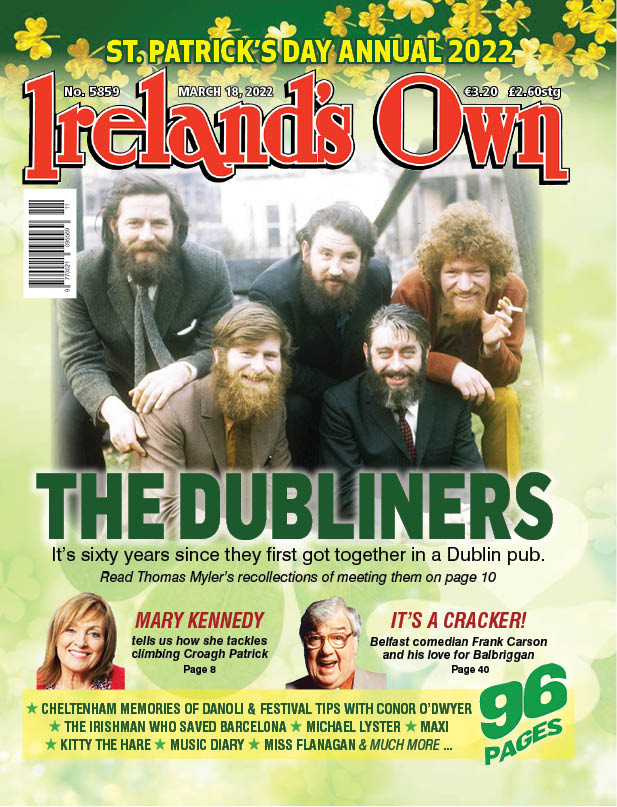
MY PIECE ON FRANK CARSON, IRELAND'S OWN, 8 MARCH 2022

 Borrowed from Ireland's Own, 8 March, 2022, my piece on Frank Carson.


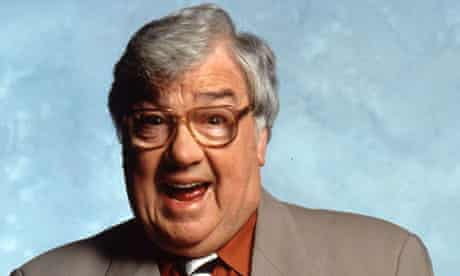
Frank Carson, who died at 87 ten years ago, was a master rat-a-tat-tat gag man, a comedian with a distinctive Belfast accent, a cackle of a laugh and two memorable catchphrases, “it’s the way I tell ‘em’” and “it’s a cracker”. Jokes would pour out of him at a rapid rate, so if one fell flat, he was already straight into the next one. It was both his adopted performing style and a way to survive some of the rough, tough clubs and pubs on the comedy circuit in the 1960s and beyond.


Frank Carson.

He could be a bit of a nightmare for chat show hosts when he went on a riff, so much so that Spike Milligan is reported to have said, “What’s the difference between Frank Carson and the M1? You can turn off the M1.”
Frank was born in 1926, the son of a binman, and raised in working-class Belfast, in ‘Little Italy’, near the docks. As a young boy in the Great Patrick Street/Corporation Street area, he recalled watching sheep, cattle, horses and carts as the main traffic in the streets where he played.

His local church was St. Patrick’s and he attended the neighbouring St. Patrick’s Christian Brothers Primary School, both on Donegall Street.

In a television documentary, he told the story of one day when he was on his way home from school, he stopped to look in a shop window and saw his reflection. Looking at himself, he said out loud, “One day, you’re going to be famous.”

He left school at 14 and trained as an electrician before becoming a plasterer. He worked the trade on local houses and church interiors, amongst others. But his ambition for fame never left his head.

At 18, he joined the Parachute Regiment and spent three years of duties in the Middle East in the 1950s. He maintained that a military career was one of the easiest ways to get a job.

On one occasion, he was shot in the leg and, in another, narrowly escaped death when a bomb exploded very close to his squad. The seven men he was with were killed. He never forgot the time he shot dead an armed terrorist who was trying to shoot him. In all, he made around forty parachute jumps for his regiment.

Back in civvy street in the 1960s, and honing his talent as a comedian, Frank began to enjoy various jobs on Irish television. He moved to England to try the northern working men’s clubs, notorious for audiences that could make or break performers. It was both challenging and educational. He stuck at it and, in hindsight, it paid off. His big TV break and launch pad to the fame he craved came in 1968 when he entered TV’s Opportunity Knocks, a prime-time talent competition show hosted by Hughie Green. He won it three times.

On the back of that success, in 1971, he was hired by producer Johnny Hamp for a new Granada Television show called The Comedians.

This was a simple format. Hamp recruited a long list of club comics to do stand-up joke-telling routines which were edited into half-hour shows. Frank appeared with Bernard Manning, Jim Bowen, Stan Boardman, Jimmy Cricket, Mike Reid, Ken Goodwin, Charlie Williams and many more over the years. 
The Comedians show was a big success.

Frank also made regular appearances on The Good Old Days, Blankety Blank, Noel’s House Party, Celebrity Squares and The Wheeltappers and Shunters Social Club, to name a few. He was a guest on many talk and variety shows. He also dabbled in children’s television with appearances on the whacky Saturday morning show Tiswas, and took on occasional acting roles. In 1985, he was surprised at Heathrow Airport by Eamonn Andrews for a This Is Your Life episode.

Away from showbusiness, he devoted considerable time to charity work. He raised millions of pounds over the years and could claim credit for his part in the Variety Club of Great Britain’s efforts to fund Sunshine coaches for the underprivileged. He promoted integrated education. In 1987, Pope John Paul II made him a knight of the Order of St Gregory at a private audience in Rome.

Back in the 1950s he and his wife, Ruth, spent their honeymoon in Balbriggan, the Fingal coastal town, fell in love with the place and made the decision to live there. Frank served two terms as Lord Mayor and became a much-loved ambassador. He is quoted as saying, “Balbriggan is my favourite place in the world.” He wrote and recorded a song called Lovely Balbriggan with You’re a Cracker on the b-side.

He made a few friendly jokes about Balbriggan. “On a clear day you can see the Irish sea. On a rough day, you’re in it.” “It’s fifteen miles from Sellafield. You can put your arm in the water and get a free x-ray.” The song is sentimental: “Oh Balbriggan, lovely Balbriggan, jewel by the sea, though I’ve done some roamin’ I’d rather be home in Balbriggan by the sea.” The pop charts were untroubled by the record, but the people of Balbriggan loved it.
Frank Carson was a comedian to the very end. In 2011, he was diagnosed with stomach cancer but happily accepted an invitation to attend a Variety Club dinner at Claridge’s Hotel in honour of the Duke of Edinburgh’s 90th birthday. After lunch, there was an afternoon of comedy. Frank took it in his stride and though unwell, went down a storm with the audience and especially with the guest of honour.

Frank never lost his connection and love for Belfast. As his career progressed, the family moved to Liverpool and later set up home in Blackpool where he succumbed to the cancer and died at 85 on 22 February 2012. He was a great family man, comedian and humanitarian. 

He really was a cracker!

Thursday, 3 March 2022

HAS ANYBODY HERE SEEN KELLY? MY BOOK


World Book Day 3 March, 2022

In 1960, my father, John Cushnan, left our Belfast home, his wife and seven young children and vanished, The next we heard of him was when we were told he had died at 57 in 1982, in Clapham, London.  In his Clapham years he reinvented himself as John Kelly from Derry. Apart from anything else, he left us with a mystery of 22 missing years. This is a story of his cowardly abandonment of his family and of my heroic mother, Rita, who raised seven children single-handedly.

This memoir can be purchased here:  https://www.amazon.co.uk/Has-Anybody-Here-Seen-Kelly/dp/1803022450/ref=sr_1_1?crid=3F2NZ9WTVWAAE&keywords=joe+cushnan&qid=1646335908&s=books&sprefix=%2Cstripbooks%2C51&sr=1-1


Tuesday, 1 March 2022

A FORCE LIKE NO OTHER: THE LAST SHIFT BY COLIN BREEN


A Force Like No Other

The Last Shift


By


Colin Breen


https://blackstaffpress.com/a-force-like-no-other-3-the-last-shift-9781780733319


This is book 3 in a compelling and important trilogy comprising stories and memories from officers who served in the Royal Ulster Constabulary (RUC) during Northern Ireland’s so-called Troubles.


Some of the recollections describe the horrific events of those times, of cold-blooded murder, attempted murder, severe injuries, mental anguish, and police officers’ lives always on alert, always on guard whether on or off duty.  Any mistake in a routine or misstep on a procedure could have resulted in death or injury, and sometimes did.


The everyday duties combatting terrorists were coupled with routine crimes like burglary and robberies, but often behind a hedge or in the shadows someone’s finger was on a trigger or close to pressing a detonator whenever and wherever the police attended an incident.  Hoax calls to lure officers to an ambush were frequent.  Sometimes the outcomes were safe enough but other times officers weren’t so lucky.


The mental pressures were enormous as officers had to look at dead bodies, badly mutilated bodies, bodies with missing limbs and, occasionally, body parts scattered over a wide area after full impact explosions.


Police officers’ families too had to be aware of the risks and dangers of someone ready to attack homes. Wives and husbands of officers would hope and pray that their loved ones would return home after their shifts.  “Sitting at home listening to the clock tick, dreading a knock on the door, having to keep feelings bottled up …………..”  Nothing was certain, except worry and anxiety. 


But, not everything in this fine book is as serious as described.  There are moments of humour. (When you buy the book, look out for the officer who went for a pee behind a bush and then witnessed the bush walking away.  Or the Chief Constable and the pheasant.  Or the one about elephants on the road.)  In addition, there is much evidence of camaraderie.


Colin Breen has achieved something remarkable in this trilogy by recording the memories and feelings of the contributors, human beings doing their jobs in difficult to impossible circumstances.  There is honesty here, heartbreak and everlasting sadness, but hard as it is emotionally to read at times, this latest book and its two predecessors are significant and important chronicles of specific aspects of Northern Ireland’s grim recent past. 


Highly recommended.